The Ethics of the Abyss
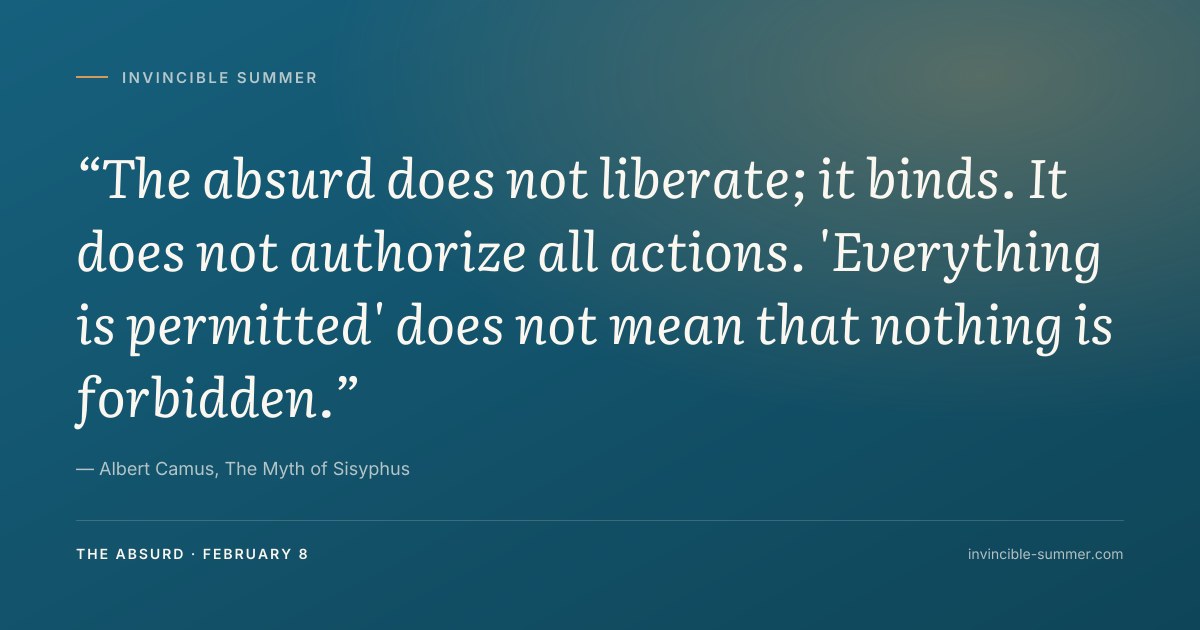
“The absurd does not liberate; it binds. It does not authorize all actions. 'Everything is permitted' does not mean that nothing is forbidden.” ALBERT CAMUS · THE MYTH OF SISYPHUS
One of the great misreadings of Camus, and of existential philosophy in general, is the assumption that if life has no built-in meaning, then anything goes. That without a cosmic rulebook, we are free to lie and cheat and take whatever we want. Camus saw this conclusion not as bold thinking but as laziness, a failure to follow the logic all the way through.
Consider someone who learns that no external authority is watching over them. One response is to treat this as a license for selfishness. But another, deeper response is to feel the weight of that freedom.
If there is no higher court of appeal, then every choice you make belongs entirely to you. There is no one else to blame and no forgiveness waiting at the end. Your actions are yours, fully and finally.
This is what Camus means when he says the absurd binds rather than liberates. The absence of cosmic meaning does not erase ethics. It intensifies them. When you cannot defer to divine command or universal law, you must take full responsibility for who you choose to be. Far from excusing recklessness, the absurd demands a more honest and more personal form of integrity, one you build yourself, with your eyes open, knowing that every decision counts precisely because nothing guarantees it will.