The Artist and the Tyrant
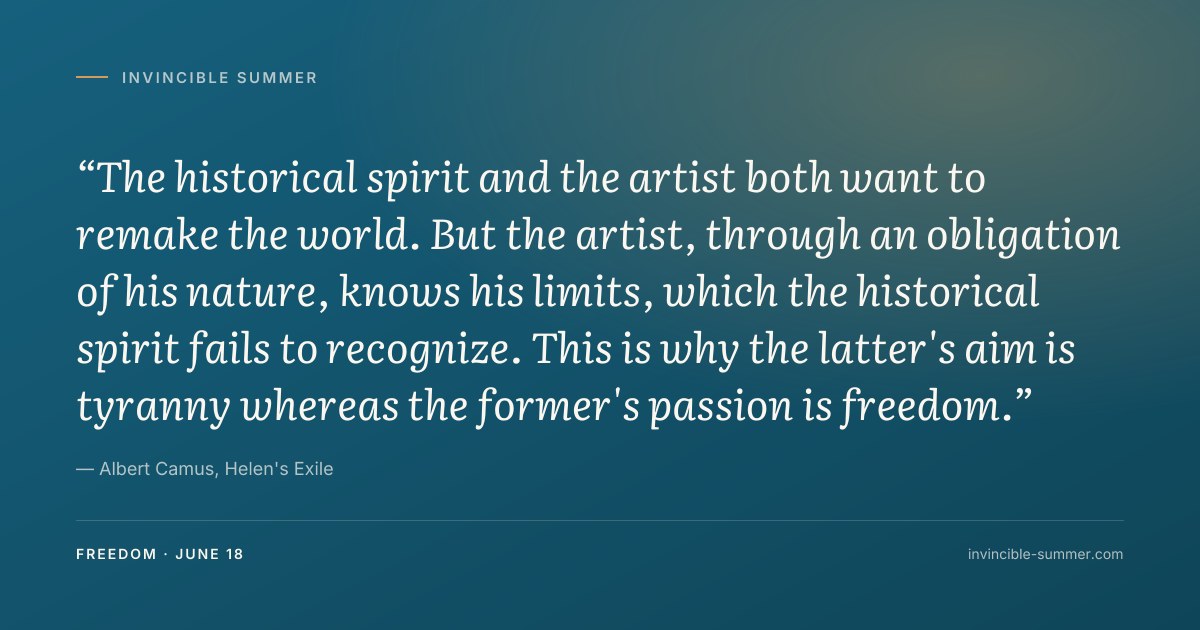
“The historical spirit and the artist both want to remake the world. But the artist, through an obligation of his nature, knows his limits, which the historical spirit fails to recognize. This is why the latter's aim is tyranny whereas the former's passion is freedom.” ALBERT CAMUS · HELEN'S EXILE
In a short essay called Helen’s Exile, Camus draws a line between two ways of trying to change the world, and he uses an unexpected pair to do it. The artist knows his limits. The ideologue does not. That single difference is why one ends in tyranny and the other lives by freedom.
A real painter cannot put everything on the canvas. A real writer cannot say everything at once. The work becomes anything at all only because the maker accepts a frame that leaves things out. That service is the condition of his freedom rather than its death.
The historical spirit, by contrast, is the mindset convinced that everything can and must be remade, with no limit and no measure, for the sake of a perfect future. It recognizes no frame. And because it recognizes no frame, it ends by sacrificing actual people to its blueprint. The dream of unlimited remaking always cashes out, sooner or later, as someone forced.
You need not be an artist or an ideologue to feel this. Anyone trying to fix a life, a family, a project meets the same fork. You can work with limits, with what the material and the people will actually bear, or you can override them in the name of the result you have pictured.
Wherever you are trying to remake something, work like the artist. Accept the limit, the form, the stubborn fact that will not bend, and create inside it. Freedom lives there and not past it.